Monday, February 20, 2012

Beware the curse of knowledge


I am sure you have played that game with friends, where you think of tune and tap it out for someone to guess. What seems obvious to you, seems to be very difficult for the other person to guess. Even though the tune plays  out in your head, they just can't hear it and guess more wrong than right answers. Well this is concept that shows up in business and with experts and companies expressing ideas often, and no matter how hard they try you just can't hear the tune. Why might this be?

Well Dan and Chip Heath, came up with a phrase to describe this gap between what you know and what others know as the "curse of knowledge". The idea is that the more you know and are deep inside a domain of knowledge, the harder it can be to express it to others. Nuances that make things obvious to you are lost in translation as you explain them to others. It is like a song that plays in your head that you can hear, but you are trying to get over to others, that cannot hear that tune.

So how might you tackle the curse of knowledge, well speaking clearly and simply about a topic helps, don't use insider words and phrases. Avoid speaking about something in a way that requires you to have lived through the experience. Taking on a beginners mindset, and thinking about what people don't know. Telling real world stories and fixing concepts in the physical world helps for some abstract topics. If you know your audience then you should have a good idea of their level of domain knowledge already and if you do not know them, then always aim at the lowest denominator and work from there. Assume that the tune you are tapping out is only in your head and how can you better help the audience pick up on the song.


Sunday, February 19, 2012

PinInterest - Discovery versus Searching


Nothing is more frustrating than having too so much information and not enough time or motivation to filter through it all to get to the one result we want. No where is this more apparent than on the internet today, even with powerful search engines like Google, the results we get back are often hundreds of pages and somewhat biased to the guy who pays the most. As a user and more importantly as a consumer we often don't get to the real information we want very efficiently if at all. It all ends up being a bad experience searching doesn't really lead to a satisfactory result in most cases. Searching is easy and simple, but finding the right results to your interest is a real problem. So what other alternatives might there be?

Well, a new site gaining popularity is PinInterest and maybe suggests another alternative for people who are searching for items online. The concept of PinInterest is simple, people get to clip things they like, the emphasis is on visual elements to keep it interesting. Users are in control of gathering things they like and sharing them with others. This along with making the site fun and enjoyable, easy to use and about interests rather than friends make for an interesting difference to normal searching. This article lists 10 reasons why pininterest is proving successful.


The new paradigm is discovery rather than searching for content. Finding people with similar interests that may have found more relevant content on the web. The experience, is much more like shopping used to be, with the catalog feel of browsing glossy images, but now with the added dimension of real time updating and user reviews. The new value proposition is that in some instances the things people are pinning are recommendations and this will be more efficient at bubbling the more valuable content to the top of those groups. For selling items to consumers this changes how we think about searching and finding items. For example if we want to find the best running shoes, instead of Google'ing the browser, we can see what actual runners prefer and are talking about most in these groups. It becomes a type of crowd-sourced recommendation engine and gives you access to those that are in the know. Users are now more responsible for filtering out the good content they find from the bad. As of right now there is also less push on those companies that pay the most to appear at the top of the list. Instead of always seeing Nike as No.1 maybe you might discover something new and better, that you hadn't expected

It has been seen time and again the power of social recommendation. Amazon and their ratings, as well as, reviews has become the norm for any company online that wants to help consumers make their selections. Psychology has recognized the power of in-group bias, where we tend to give preferential treatment to those we picture as in our own group. Also the effect of the authority bias leads us to trust the opinions of those considered experts in the group we are consulting with. These two conditions play well in the discovery form of searching, making us more likely to follow the leads that certain people may suggest rather than a series of return results from a search engine that maybe have no attributed author or social group attached to them. Other conditions that fall out of this kind of searching includes, feelings of having access to exclusive insight to maybe less mainstream content, increasing our perceptions of its value. There is also the surprise element of finding something unexpected or new that you maybe hadn't considered before and of course we mustn't forget the power of reducing choices as helping people get to a decision.

With all these powerful psychological forces acting on someone in the new PinInterest site, it is no wonder that it is already proving a very popular destination on the web and new way to discover and find content and consumables, as well as, interesting topics and subjects you can follow.

Friday, February 17, 2012

Sticky Ideas

If you are like me you have sat in a darkened room many times listening to someone drone on about some topic that at first you thought might be interesting to you, but quite frankly you start drifting off and once the talk is over you don't remember a thing about what the presentation was about or the point that was being made. Or maybe you have been in one of those company motivational speeches given by the CEO that leaves you feeling more flat than inspired. Well it is most likely that these people could have benefited from reading "Made to Stick" by Dan and Chip Heath, two brothers that decided to look into what makes ideas stick and memorable in peoples minds. Their research uncovered some interesting ways to make ideas sticky.
Sticky ideas are those ideas that have certain traits that allow us to recall the concept or meaning very easily. Dan and Chip describe them as ideas that are more like velcro in our minds, they attach themselves at many points in our neural network and as such it makes them more memorable and easier to recall later. They go on to outline what they call the SUCCESs steps to making an idea more sticky. SUCCESs steps refer to:


Simple
Keep the idea simple, people don't remember many items at once, so get down to the core of your message

Unexpected
Adding something unexpected helps you remember it, it makes it more notable in your mind if you suddenly have a twist in your idea.

Concrete
Make something tangible. Put the idea into the real world, remove abstraction.

Credible
Adding a authority or anti-authority to an idea gives it authenticity and makes it valuable

Emotional
Bringing an emotional element to the idea makes it impact people at a deeper level

Stories
This is last in the list but really it is probably one of the most important elements of a sticky idea. Adding a story element makes the idea spreadable, easier to remember and start to take on a life of it's own.

This list is a really nice summary of making ideas last and have value to those that come across them. Of course one of the immediate things that stands out to me is how these steps, are very applicable to not only presentations but also to marketing and branding efforts for companies looking to create a deeper connection to consumers. These steps are really about anything that needs to have a lasting impression on others. Whether that is employee orientation, a charity fund raiser, or a teacher giving a lesson on biology.

One final interesting part of the book didn't get much attention but was worth mentioning was how to UN-stick an idea. Of course most people want to get ideas inside peoples heads. What to do when you want to change someones ideas, the example might be some bad publicity around a product that people now associate with the brand. Their suggestion is to make an even stickier idea to replace the current one. That might include making a better comparison with a positive spin, or redirecting the public's mind towards a different enemy or goal. 

Sticky ideas are valuable and creating idea virus's or ways to communicate those ideas is a valuable skill to have. These suggested steps help get those messages out there and improve the chances of making your ideas stick. So turn up the lights go back and rethink your presentation or idea, with these concepts in mind, and this time you will more likely create an idea that will stick and have an audience not falling asleep in the dark.

Thursday, February 16, 2012

The Choice Paradox

Choices choices. Stroll down any aisles of any store, and you are bombarded by an array of different products by different manufacturers and even within each brand there are seemingly endless variations of their own products. What started out as a simple mission to go shopping for food, ends up being a huge mental task of filtering and chosing between all these products to get to the ones we actually need or want. The problem is of course, we like to have choices because it gives us a great sense of power and freedom, but the reality is these choices burden us with decision making tasks repeatedly throughout out days.

Barry Schwartz in his book "Paradox of Choice" talks in depth about this issue of having so many choices that we literally freeze in our tracks and end up instead of making choices, we walk away and make with no decision being made at all. He lays out a great example of a study that used two tables of jams available for taste testing, that one had many choices, much like you find in the super market, 24 or more varieties, then on another table there were far fewer to chose from say 6 samples. In this test the table with the least number of choices ended up making more sales of jam. It seemed as though the reduction in choice helped people in making decisions.


He suggests that there are a few factors that concern us about making choices and it is these that play in our minds and lead us to the indecision we have:


  1. Regret and anticipated regret
  2. Opportunity costs
  3. Escalation of expectations
  4. Self-blame


In psychology this is called the decision paralysis, the mere existence of choice, even between equally good items, paralyzes our minds in making the choice. We fall into the trap of making comparisons and weigh up the differences between the items. This requires such a mental effort that we often when faced with too many items that have many very similar characteristics, that we prefer to not reach a conclusion and walk away, to stop the mental effort required to make that choice.

So how might we over come this problem of being surrounded by choices?

The term "satisficing" is a term that comes up many times in talking about making choices. Going with anything that is close enough to the goal and making do, without the mental burden. Barry Schwartz gives many other great examples of situations of making choices and finding satisfaction in our choices. This is definitely one way to overcome the problem, reducing the need to make so many comparisons.

Another approach to helping people make choices is to setup a "default" state of something that makes some sensible decisions for them. A great example might be allocating money to a pension that defaults to a general fund that takes the S&P 500 for example. Not necessarily the best choice, but a good starting point and reduces the decisions that might stop someone contributing in the first place. This is discussed in more detail in the book "Nudge" by Richard Thaler. That proposes that people can be helped in make good choices by nudging them in the right direction.

Here is a small list of things you can try that can help you make decisions in the future.

1. Have a clear direction or goal of what you are trying to acheive.
If you are picking something as simple as jam, ask what is really important in the decision, organic, type of fruit maybe? Then be willing to accept that nothing is perfect, and maybe try something, with the knowledge that most things can be returned or changed out next time you shop. Sometimes having a very clear statement of intention can help people understand the correct response to any question that might arise. Knowing the ultimate goal of any choice can help make that choice, a little like having a default answer, "the customer is always right". Dan & Chip Heath talk about this more in this article.

2. Take a break from the decision making, relax and write them down.
Sometimes the indecision comes from getting stressed about the possibilities and the unknown outcomes. Some decisions are very important and some are not make sure you are allocating the right level of concern about you choice at the right time. Writing stuff down can help you get your mind "in order". Writing pro's and cons out can make things clearer for those bigger decisions. It also allows you to share your thoughts with others and hear opinion which can help here other arguments. Of course this is overkill for something as trivial as jam.

3. Gather more information Or Use Intuition
Sometimes indecision comes from not knowing enough, or being stuck in a particular mind frame. Try doing more research, find out others ideas and opinions. Maybe look at other similar areas of expertise, see how others may have solved a problem or approached a decision and their outcomes may have been. Sometimes you need to take a step back and see the bigger picture of what the decision means to larger system or project. Sometimes you need to trust you instincts, as Malcolm Gladwell would suggest in his book "Blink" sometimes decisions have already been made at a deeper subconscious level, we just need to listen a little to our intuition. Ask the questions that encourage you intuition, avoid the question why for example, use questions that start with what or how, that have a more positive start to their framing of the question for decision making.

4. Be willing and open to failure and starting over
Even with the best intentions things can fail. Sometimes the unknowns are overwhelming and if you spend too many hours thinking about what might happen with a certain choice you will not even try to move forward. If you accept that things may fail then you can start to experiment, using the methodology of design thinking you can begin to make small bite sized incremental steps to start answering all your questions you may have and begin to see the results of your assumptions with prototyping. I am not saying to start out with failure in mind, but be willing to bounce back if it happens. What are you willing to risk to move forward versus what will you gain, keep the risks reasonable.


Wednesday, February 15, 2012

7 things you need to find your flow moments


How many times have you sat down to do something and suddenly you look up at the clock and time seems to have slipped away from you and suddenly you realize that you have spent hours working on something but it felt like 10 minutes of time passed. Time flies when you are having fun, is how my mum would summarize this effect. Well it seems that these moments can be attributed to being in a certain mindset and when certain conditions are met these moments are repeatable.

Mihaly Csikszentmihalyi a Hungarian psychology professor has studied these moments of "flow" as he calls them and has outlined the criteria for them to occur. Here are 7 things that will help you find your flow moments.

1. The task has to have a chance of being complete-able
2. You should have time set aside for concentrating on the task without distraction
3. The task needs to have clear goals, so you know what you are aiming to work on
4. It helps to have immediate feedback, so you know how things are progressing
5. Having deep but effortless involvement, will help reduce worries that may inhibit progress
6. You need to have a sense of control over the outcome of what you are working on
7. It helps to not have a conscious reminder of time, then time will cease to have meaning.

Flow moments facilitate concentration, by making everyday activities distinct and meaningful from normal everyday activities. They also make control possible giving a sense of self fulfillment. These moments are very similar in characteristics to what Daniel Pink, would refer to as "Drive" the motivational factors for intrinsic desires in performing any cognitive tasks. Daniel suggests in his book, that people are inspired to work harder at cognitive tasks when they are aiming to fulfill 3 fundamental needs, mastery, purpose and autonomy. This to me falls inline with what finding flow is all about. That sense of being inspired to increase ones level of mastery, with a sense of control and with some guiding purpose.

Flow moments require:

1. Rules (not too open ended)
2. Require learning new skills (mastery)
3. Set up goals ( have purpose)
4. provide feedback (sense of achievement)

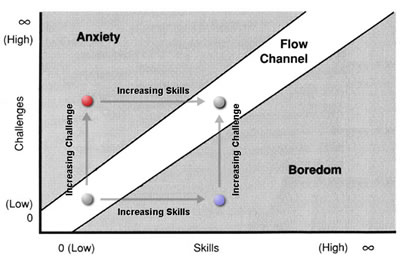
This concept is nicely summarized visually in a couple of graphs. The first show the channel of flow, between anxiety of a task being to hard, but challenging enough to make us work at it, and boredom from a skills stand point that the task it too trivial that it doesn't challenge us enough and is uninspiring.


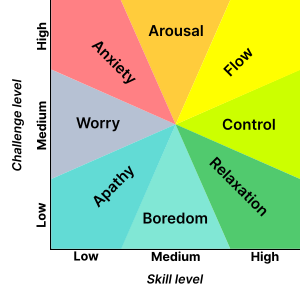
The other graph shows a more granular break down of the states of mind that occur around the flow channel.


So next time you start into a project and the time disappeared all too quickly, thin to yourself what made that happen and how you may go about making it happen again. Try to make every working moment a flow moment and your sense of purpose and self fulfillment will surely grow.

Measuring Usability - SUS Questionaire

Producing interfaces and software experiences always produces questions of usability. Is something ultimately usable by the end user, are they able to better perform their task, be more efficient and are they more satisfied with the interactions. These questions are the goal of usability studies, throughout the design process. The problem however is firstly the amount of money, effort and time needed to perform a through usability study with a diverse user base, but the other problem is interpreting the results accurately to know what fixes are worth making and what works and what doesn't.

One system that attempts to addresses these questions in an optimized way is the System Usability Scale (SUS), published by John Brooke about 20 years ago, that asks 10 simple questions that require a rating from 1-5. It is based on the Likert scale questionaire. The questions are outlined here that gives results for overall usability and user satisfaction index. This site goes into greater depth, on the subject.


The System Usability Scale

The SUS is a 10 item questionnaire with 5 response options. 
  1. I think that I would like to use this system frequently.
  2. I found the system unnecessarily complex.
  3. I thought the system was easy to use.
  4. I think that I would need the support of a technical person to be able to use this system.
  5. I found the various functions in this system were well integrated.
  6. I thought there was too much inconsistency in this system.
  7. I would imagine that most people would learn to use this system very quickly.
  8. I found the system very cumbersome to use.
  9. I felt very confident using the system.
  10. I needed to learn a lot of things before I could get going with this system.

The SUS uses the following response format:


Scoring SUS

  • For odd items: subtract one from the user response.
  • For even-numbered items: subtract the user responses from 5
  • This scales all values from 0 to 4 (with four being the most positive response).
  • Add up the converted responses for each user and multiply that total by 2.5. This converts the range of possible values from 0 to 100 instead of from 0 to 40.
Interpreting these results it is important to understand that these are not a percentage, even though they are in the range 0-100. 

While it is technically correct that a SUS score of 70 out of 100 represents 70% of the possible maximum score, it suggests the score is at the 70th percentile. A score at this level would mean the application tested is above average. In fact, a score of 70 is closer to the average SUS score of 68. It is actually more appropriate to call it 50%.  


When communicating SUS scores to stakeholders, and especially those who are unfamiliar with SUS, it's best to convert the original SUS score into a percentile so a 70% really means above average.


An example of calculation and table.

SUS
How to score the SUS
After collecting the data go into the next step to grade usability.
a. Replace each answer with a number from 0 to 4.
Specifically, for questions 1, 3, 5, 7, 9 the score contribution is:
  • Strongly Disagree = 0
  • Disagree = 1
  • Not sure = 2
  • Agree = 3
  • Strongly Agree = 4
For questions 2, 4, 6, 8, 10 the score contribution is the opposite:
  • Strongly Disagree = 4
  • Disagree = 3
  • Not sure = 2
  • Agree = 1
  • Strongly Agree = 0
b.  Add scores and multiply total by 2.5.  Calculate the mean to find the score.  The total score should end up with a range between 0 and 100.  The highest the score the more usable the website is.
Any value around 60 and above is considered as good usability.


The SUS should never be a substitute for good user testing and techniques. It is a low cost technique that can be used in parallel with user testing and enhance/validate the results.

Tuesday, February 14, 2012

Design Research for Innovators


When you have an existing product or service then research techniques and methodologies already exist to gather and analyze information about it, to start planning the next version and future improvements. Building up a data collection and then analyzing existing users and systems through market research tools and surveys, as well as focus groups will yield a lot of great data to wade through to help incrementally improve existing designs.

However, if you are starting a new product or service that no one has ever seen before or had the opportunity to use, what methods can you use in this situation? There is not always something to test against and people cannot have accurate opinions about something they have never seen or used. Jane Fulton Suri chief creative officer at IDEO, suggests in her article about design research, that innovation requires a new approach to tackle the unknowns. Design research techniques can help in future thinking of new products and service insights. She explains that innovation is mostly open ended in its requirements and can be very subjective in nature. She suggest that what is required is what she calls "design research" opposed to more traditional research techniques, that still uses the analysis of objective evidence as before, but the research is enhanced with extra exploration due to the lack of applicable data. These include:

Synthesizing of evidence,
Exploration of analogies and extreme cases,
Recognition of emergent patterns,
Empathetic connection to people's motivations and behavior,
Intuitive interpretation of information with impressions from multiple sources.

These considerations are used to expose patterns with peoples behaviors and experiences, as well as, explore reactions and responses. The purpose of this research is to extend our knowledge and understanding. These allow the researcher direct efforts to probe and prototype against, which will more likely give key insight on unknowns through hypothesis and experimentation.

Design research's value is in inspiring our imaginations and inform our intuitions. Successful design research as Jane suggests requires both a cultural transformation in organizations and perpetuation of those transformations to allow innovation to survive and grow. Design research requires the individual to get out of the office and be where the customer is and see what they see. It is important to get first hand experience out in the field. Design research can be rich and delivers not only facts, but insights into those facts and reasons behind them. She goes onto emphaize that people have needs, motivations, habits and perceptions that all need to be taken into account in new product and service design thinking. Good research should uncover these nuances and allow the experimenter to gauge their ideas against this knowledge.

She summarizes with three different approaches to design research that can address open questions with regards to innovation and how they can be performed and implemented.


Generative Design Research
This is an empathetic exercise, it is descriptive and factual but also speculative and interpretive. We are looking for emergent patterns, challenges and opportunities that can be address with innovation and design thinking. It can be performed by shadowing specific people and observing their behaviors. Having people keep diaries of moods and significant events. It is interactive and contextual and not based on self report or opinions. There is also room for more traditional market research, and trend information searching. The aim is to create a framework for thinking about the domain for innovation.


Evaluative/Formative
Learning feedback loops are useful here, with user input and consumer insight gained from using sketches, telling stories. Producing videos and prototypes can be very valuable here to help demonstrate the issues and try potential solutions. The aim is to tangibly represent an idea, probing and asking questions. It gives a chance to address questions and uncertainty as it occurs. It allows you to check peoples reactions and refine assumptions. Collaborative discovery and creation works well in this research method. Using prototyping techniques such as theater(bodystorming) and paper prototyping.


Predictive
How confidently can we predict success? Looking ahead to estimate the potential of an idea and the future opportunities that maybe be available. This requires more of a business mindset, and is a good skill to acquire, especially for designers. Looking for potential markets and determining viability of ideas. Running live experiments and having labs that run experiments online is good practice.